
Rethinking the Path to School
The central impulse of Waldorf education is to support the fullest development of each individual—through a living integration of body, soul, and spirit so it follows that our practices must evolve alongside the children we serve. As human beings and societies change, so too must the expression of our core principles.
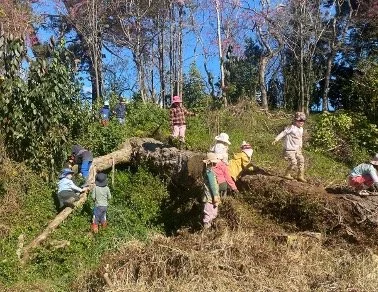
At our small country school on the east coast of the North Island of New Zealand, the question of renewal has come into sharp focus in recent years as we find ourselves needing to respond in new ways to what appears to be a steady rise in childhood anxiety. Our experience, which I suspect is not unique, is that increasing numbers of children are finding it difficult to step into the unknown. Transitions that were once relatively smooth have become more fraught. The move from nursery to kindergarten is harder than before, and the step from kindergarten into Class One can be especially challenging.
To understand why this is, it is helpful to consider what is actually being asked of a young child entering school. First, they must learn to cooperate with a large group of peers—often around 25 to 30 children—for many hours each day. This is, in fact, a highly unusual human situation. Such dense and sustained peer groupings are a social construct, not something that arises organically in nature. For many young children, such an experience can feel overwhelming. In our own context, with small classrooms and unfamiliar companions—some who stand too close, some whose responses are unpredictable—the process of learning social norms, rhythms, and expectations has become increasingly difficult.
The second capacity required is the child’s willingness to accept the authority of a single adult who is not a parent. For children raised within strongly child-led approaches, or in families where adults consciously act as facilitators and mediators of the child’s environment, this can be a significant shift. The notion of following the guidance, requests, or example of another adult does not always arise naturally from their prior experience. For some children, it lies well beyond what feels familiar or manageable.
And yet, within Waldorf education, the loving authority of the teacher is not incidental—it is fundamental. The teacher as leader is central to the pedagogy and plays a vital role in creating a healthy, cohesive classroom culture. The question, then, is how we can help children grow into this capacity—how we can support them to develop the “social muscles” needed for school, in ways that minimise distress for the child, their peers, and their teachers.
In response, we have developed a transition programme called Te Arakura—a Māori phrase meaning “pathway to school.” The intention behind this play-based initiative is to shift the emphasis away from the endpoint of producing a “school-ready” child, and instead to honour the journey itself. Rather than pushing towards readiness, we seek to accompany the child through a series of smaller, more secure steps—steps that build confidence, resilience, and trust over time.
Like many small schools, we faced practical challenges. Space was limited; at times, learning programmes were housed in unconventional settings, including a yurt. Yet our campus also offered a remarkable resource: sixteen acres of farmland, gardens, native bush, and a flowing stream. Out of necessity—and inspiration—the programme found its home outdoors. Although ‘home” is a rather grand description for what is, in reality, a modest lean-to structure beside an old farm shed.
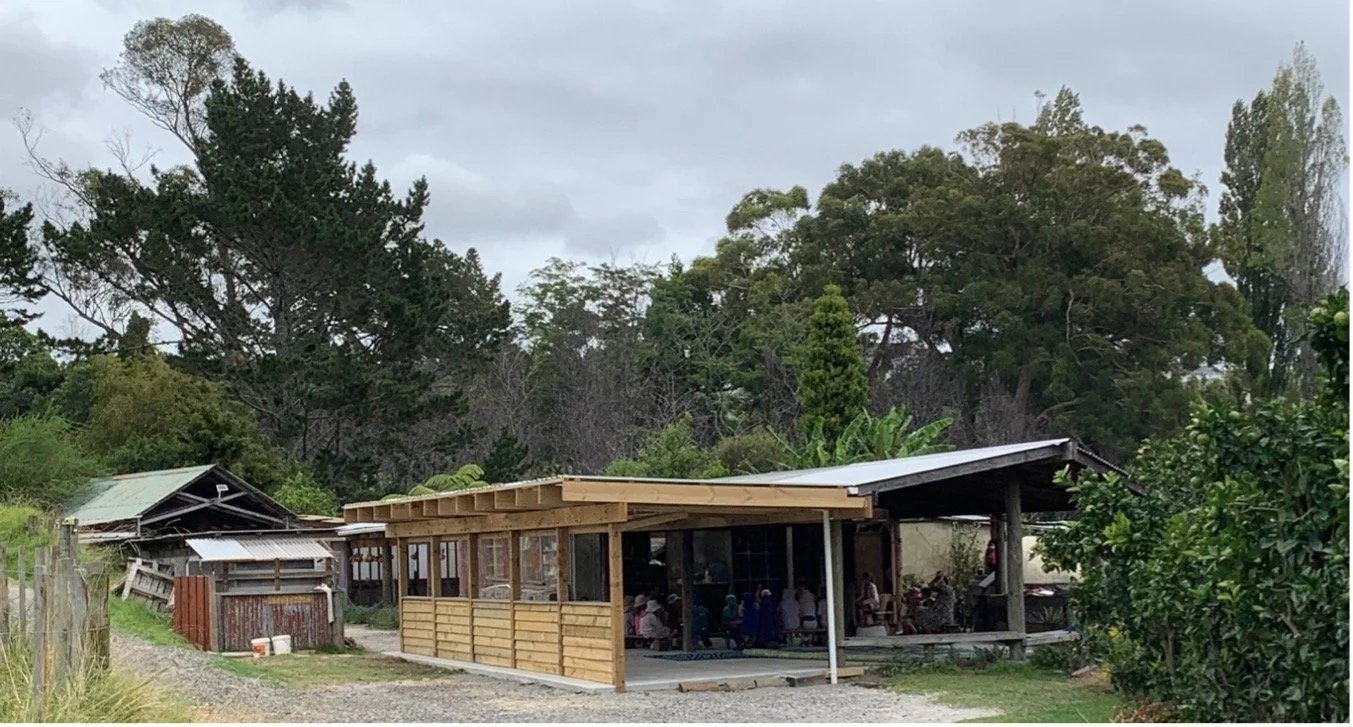
What emerged was a work-and-play environment that addressed what we increasingly recognise as two significant deprivations in modern childhood. These are movement deprivation and nature deprivation. After many years experimentation including some reasonably large failures, we have settled on a remediation of these two things as our starting point and vision.
In our experience, its benefits are both immediate and profound. Nature offers a gentler sensory environment, reducing the overload that many children experience indoors. At the same time, open, unbounded spaces invite free movement which can restore a fundamental aspect of healthy development that is often restricted in conventional classroom and learning to work and play outdoors is a very different experience from life within the kindergarten setting. It is more complex in important ways and noticeably more demanding.
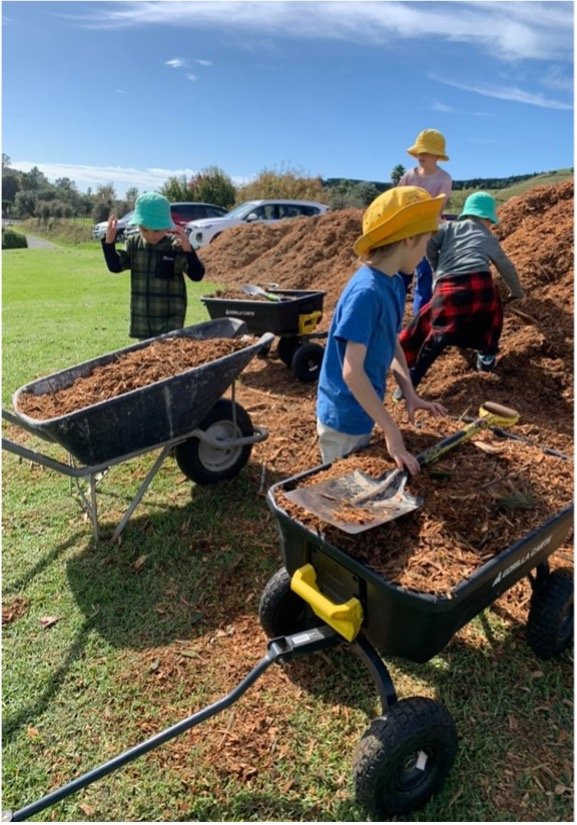
Nature has a tendency to dictate curriculum content. A recent weather event offered the opportunity for a great deal of meaningful work moving mulch created by a tornado which felled our neighbour’s trees.
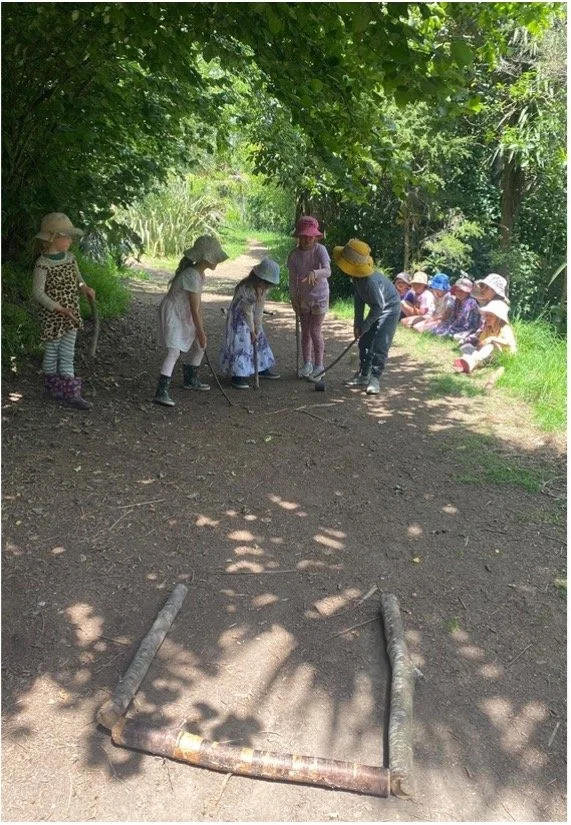
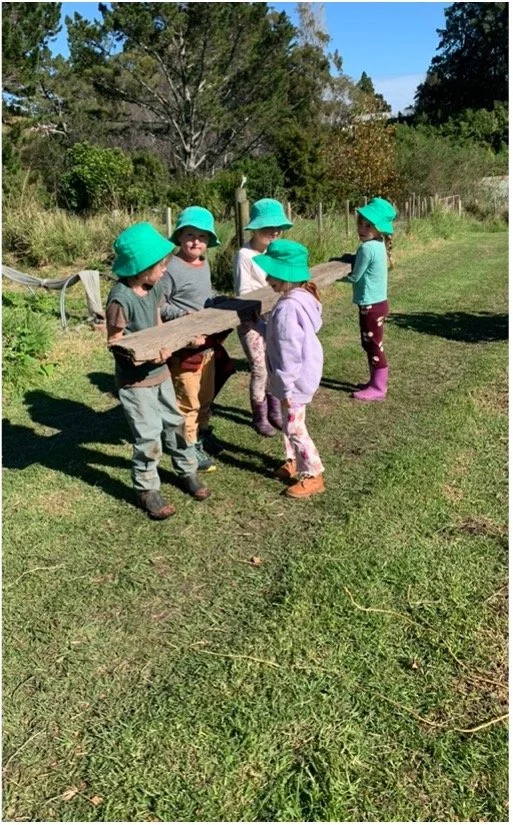
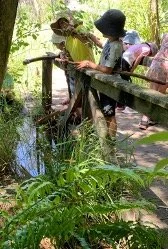
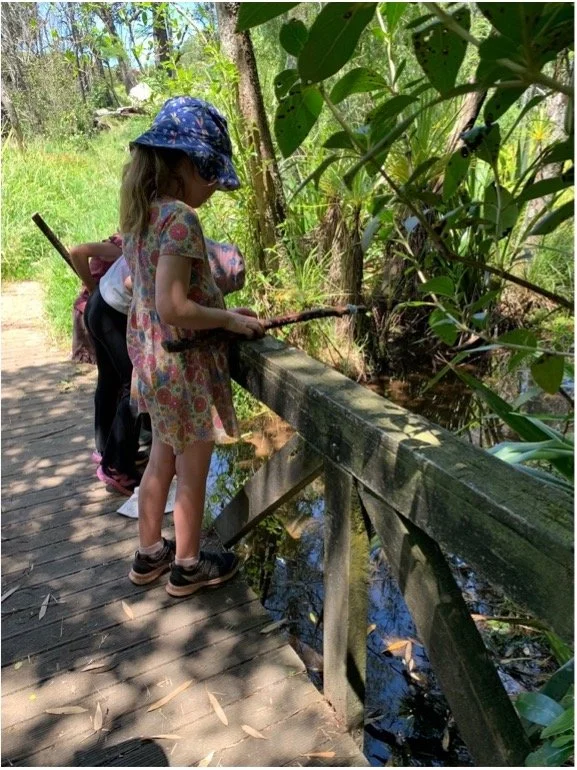
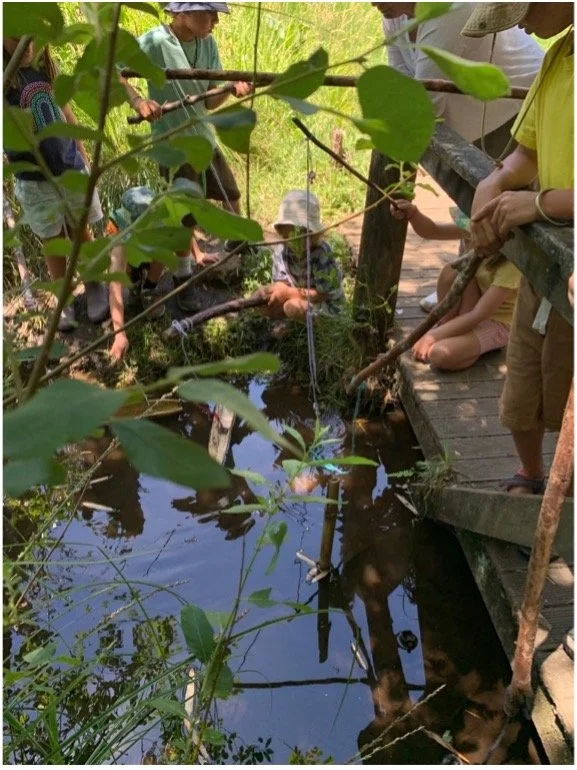
Play opportunities abound also with abundant opportunities for problemsolving, experimentation and cooperation. We are blessed with a stream which offers hours of quiet wonder.
Our transition to school program, despite its apparent simplicity, serves as a meaningful threshold into a new stage of learning by providing above all else time and space for young learners to find relationship with each other as a first step towards being a successful community of learners.
Mary Tait-Jamieson
Principal
Tauranga Waldorf School