
Play at Kōwhai Tui
A sharing by Laura McGregor, lead baby Kaiako at Kōwhai Tui in Kirikiriroa / Hamilton - if you are looking for a home away from home, for your tamariki aged 6 months - 5 years, be in touch through their website HERE.
Welcome to the Kōwhai kitchen where our chefs are busy working.
Four tamariki are around the table outside with pots and pans, they’re discussing between themselves what they’re making.
James* is making drinks and Oscar is making sushi.
Oscar is mixing an egg for his sushi he’s breaking up sticks and putting them into the teapot then using another stick to mix it all up.
James, who is making drinks, is also mixing his cup with a stick as he breaks up leaves.
“We’re making a fire” “cooking on the fire”, they say and start breaking up sticks for firewood. After a few minutes of doing this Oscar picks up a big pot and by discussing fire the idea of birthdays is ignited, and he brings the pot to me saying “happy birthday!”. He holds the cake out toward me so I can blow out the candles.
Another child, Lizzie, is standing by the table watching with interest. Oscar takes his cake over to the table again and mixes it up as then takes it to his friends singing “happy birthday to you” he holds it out and waits for them blow out the candles. He then took the cake around to James and Lizzie who each put their hand into the pot and pull out a piece of cake and eats it.
In this play at Kōwhai, I can see tamariki drawing on their own experiences, sushi is something they enjoy eating at home, and they have had birthdays recently, where they enjoyed eating cake, blowing out candles, and having “Happy Birthday” sung to them.
I can also see them imitating the real work of the adults around them, preparing and mixing food in pots and cups to eat.
These tamariki are all under the age of 2 1/2.
I can see many social skills at work, involving others in their play, being open to the ideas of others and incorporating them into the play, learning to share, to take turns, to consider others, finding ways to join others in play.
They are practising their recently acquired language, using it to involve others, to negotiate, and to share ideas.
Rudolf Steiner said: “If a child has been able in his play to give up his whole loving being to the world around him, he will be able, in the serious tasks of later life, to devote himself with confidence and power to the service of the world."
In my many years of work with very young children I have noticed that, in order to truly enter play, children need to have a strong sense of belonging and well-being. Once they have built strong relationships with the adults around them, and their physical and emotional needs are taken care of, then they are truly free to give themselves over to play in the way I witnessed in this moment, and the type of play Steiner talked about.
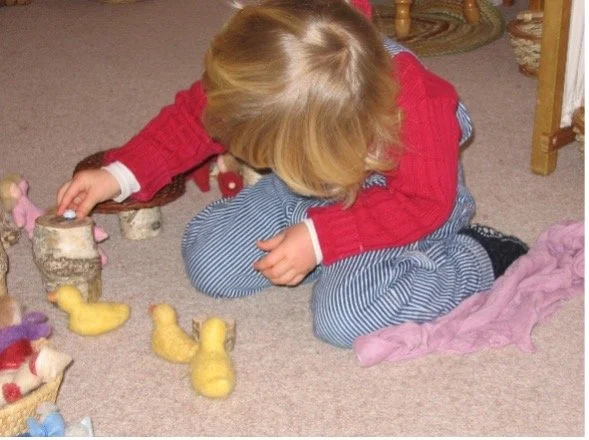
A child playing with hand-crafted toys, deep in play.
“We are fully human only while playing, and we play only when we are human in the truest sense of the word.” – Rudolf Steiner
True free play happens organically; it comes from within the child and it is how they process their experiences in the world. It is therapeutic. It’s free from outcomes and goals, agendas and adult input.
Our role as Waldorf teachers is to facilitate this type of play, to provide the environment in which this play can take place. We do this through strong daily rhythms, so they know what to anticipate and can therefore be relaxed in themselves. Through focusing on building strong relationships between children and teachers, so their emotional and physical needs are well nurtured, making them at ease in the environment and confident to explore and experiment.
No matter how homely the Kowhai environment may be, home life will always be different. Your child may be an only child, or if your child has siblings, they will be at a different ages and stages, so how can you support play at home?
Firstly, having time and space at home to just be. I know life is busy, especially with work, but having unstructured time at home gives them the opportunity to delve into play.
Your child may want to play with you, which is great, they do learn by imitation after all, especially when it comes to language. Try to follow their lead and respond to their interactions rather than adding your own ideas to their play. And when you can, take a step back and let them go about their play independently, it can be helpful to move on to some work that you need to get done, such as the dishes or other housework.
If your child is having trouble finding play independently, it can help if they see you being busy too, they may like to help you with your work, they do love to help after all, and often helping you fold the washing or do some other task will bring about an idea for play in them and they will move away to follow that urge, often taking a face cloth or other part of your work with them to use in their play.
While child’s play may sometimes not look like much to us as adults, there is so much going on for the child. Play is essential to the healthy development of human beings and is the foundation for thinking and learning in the school years, and at Kōwhai Tui we will always focus on providing an environment for play to thrive.
*Names of children have been changed.