Curious about Steiner Education?
Maybe you've heard the word "Steiner" or "Waldorf" mentioned at a friend's house, seen a photograph of children engaged in simple, holistic play with natural materials, or noticed a playgroup, kindergarten or school in your town with a feel that's a little different from what you're used to. Maybe you're a parent wondering if there's another way to raise your tamariki, from their very first playgroup right through to their secondary years. Maybe you're a teacher who has started to feel that something is missing. Or maybe you already have a child enrolled in a Steiner playgroup, kindergarten or school, and you're simply curious to understand more of the "why" behind what you're seeing.
Whoever you are, and whatever brought you here, ngā mihi nui. You're welcome in this kōrero.
Why People Find Their Way Here
People arrive at Steiner education from many different starting points. Some come with a family history of Steiner Waldorf education. Some come because a particular philosophy or approach to childhood and adolescence resonated with something they already believed. Others encounter a Steiner playgroup, kindergarten or school almost by chance and feel something shift.
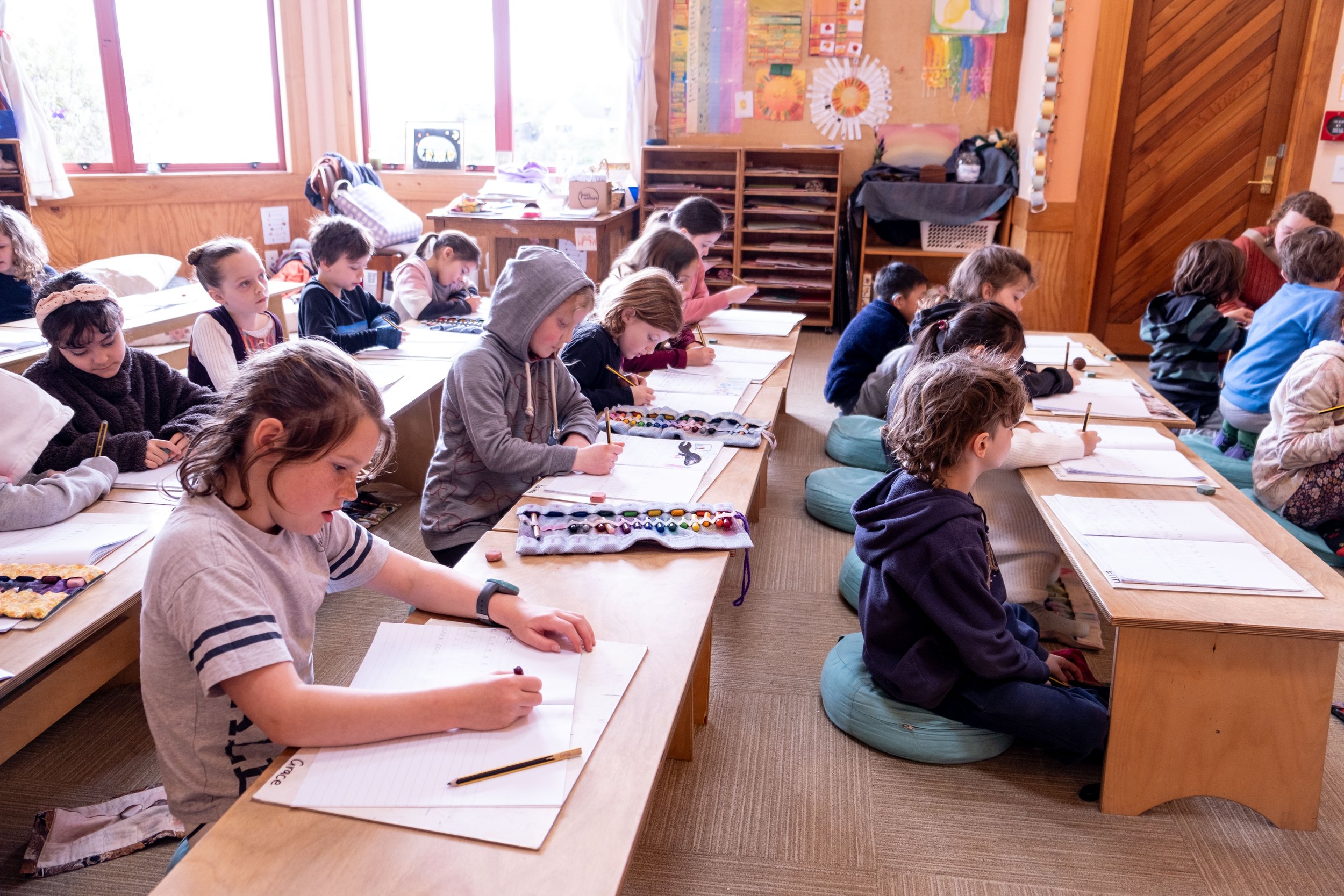
Parents often speak warmly about what they see in the day to day, whether their child is in a playgroup, a kindergarten, or further along in their schooling. Imagination, movement, and unhurried exploration, treated as essential and valuable work in their own right. A pace that allows their child's developmental readiness to lead the way, at every age and stage. A rhythm, whether daily, weekly or seasonal, with plenty of time outdoors and away from screens.
Educators often arrive from a range of backgrounds, some from within education generally, and find themselves drawn to a philosophy that takes the whole human being seriously: body, feelings and thinking, not just the parts of a child or young person's development that are easiest to measure or record.
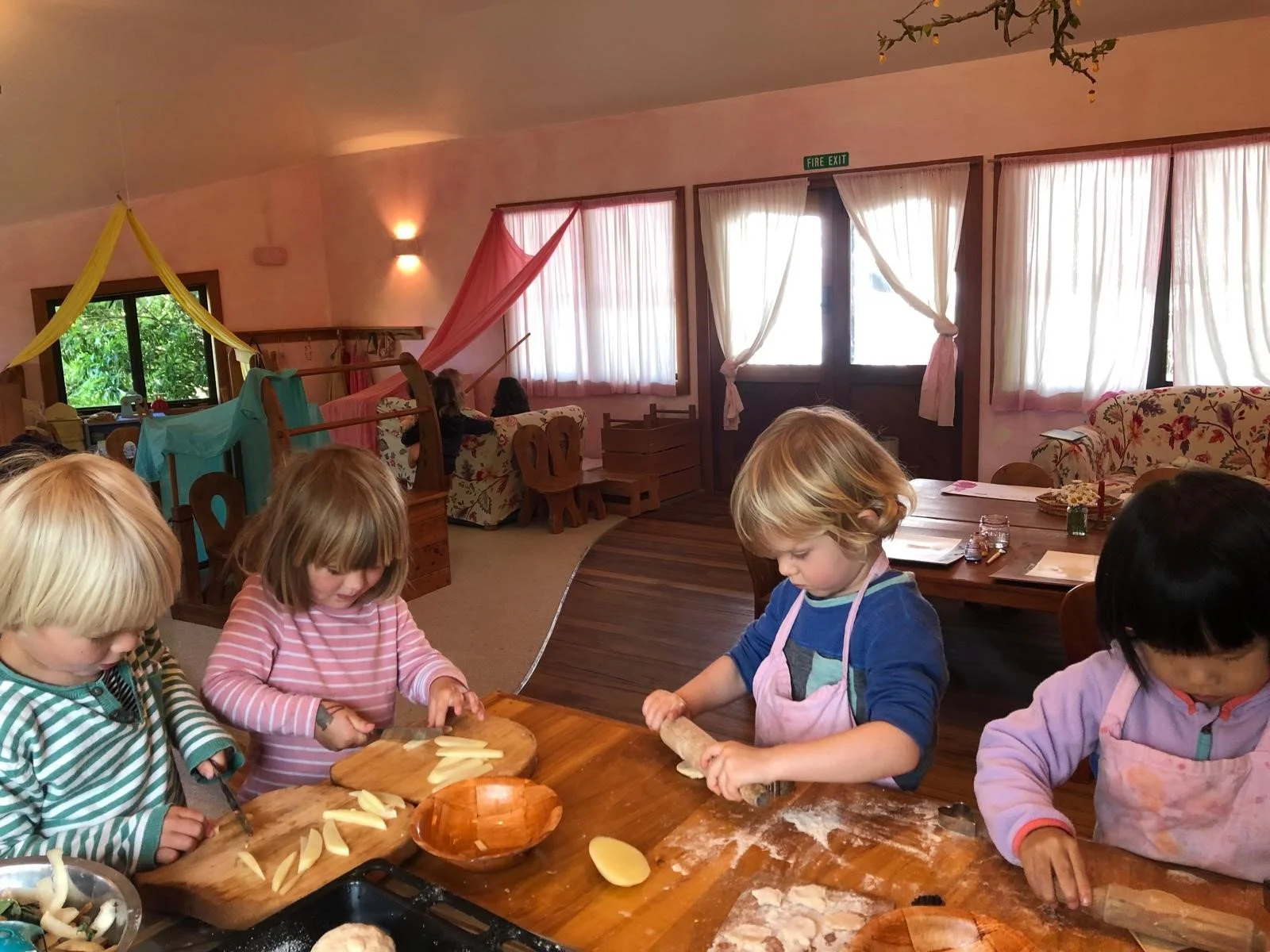
And some people are simply drawn to the atmosphere. There's a warmth and simplicity to a well-run Steiner Waldorf setting, whatever the age group. Natural materials, holistic play and learning, and equipment chosen to meet children's developmental needs without placing a heavy demand on the earth and its resources. Handmade resources. Gentle voices. A rhythm children and young people can rely on. It doesn't take a teaching qualification to feel that something thoughtful is happening in these spaces.
What Steiner Waldorf Education Offers
At its heart, Steiner Waldorf education is built on an understanding of childhood and adolescence as unfolding in stages, each with its own way of learning and its own needs. In the playgroup and kindergarten years, children learn through imitation, through their whole bodies, and through repetition and rhythm. As children move into the primary school years, learning is carried through relationship, story, image and rhythm as much as through direct instruction. In the older years, young people are increasingly invited into their own thinking, discernment and independent judgement. This unfolding shapes everything else.
Rhythm and predictability. Days, weeks and years follow a gentle, repeating pattern, whether that's a playgroup session, a kindergarten day, or a school's main lesson blocks and festival calendar. Children and young people know what's coming, which offers a deep sense of security. The rhythm itself becomes a teacher.
Reverence for each stage of life. Every stage, from playgroup through to the senior years of school, is valued as complete and meaningful in itself, not only as preparation for what comes next. There's trust that if each stage is given what it truly needs, sensory experience and imaginative play in the early years, and increasingly independent thought in the years that follow, the capacities needed for adult life will develop in their own time.
The kaiako as a guide who changes with the child. In the playgroup and kindergarten years, the kaiako works as a living example, consciously shaping their own movements, tone of voice and care for the environment, because young children absorb all of it. As children grow, the relationship shifts, and the kaiako or class teacher becomes someone who guides through story and relationship, and later, someone who supports young people to think and question for themselves.
Connection to the natural world and the seasons. Nature isn't a topic on a curriculum plan; it's a daily and yearly companion, from playgroup through to school. Children and young people spend time outside in most weather. Seasonal festivals mark the turning of the year and connect them to something larger than the classroom.
Art and craft woven through everything. Wet-on-wet watercolour painting, beeswax modelling, handwork, seasonal craft, storytelling, and music aren't "extras" at any age. From playgroup through to school, they are core ways children and young people come to know and make sense of their world.
The Role of a Steiner Kaiako
Whether you visited a playgroup, a kindergarten, or a school classroom, some things would be immediately visible, and others would take longer to notice.
You'd likely notice how few overt "teaching moments" there are in theearly childhood years. A Steiner kaiako rarely gathers young children to explicitly instruct them in letters, numbers, or facts. Instead, they set up an environment rich enough, and a rhythm reliable enough, that learning happens indirectly, through play, through helping with real tasks like kneading bread or sweeping, and through story. In the school years, this shifts into a rich, image-based way of teaching, where a class teacher might stay with the same group of tamariki for several years, coming to know them deeply.
You'd notice a different relationship with materials and resources at every level. Toys, tools and learning materials are often unfinished in form, natural in origin, and chosen with real care for their impact on the earth, so that children and young people's own imagination and thinking do the finishing work.
You'd notice how much the kaiako observes rather than intervenes. There's a discipline to stepping back, allowing children and young people to work through social conflict, physical risk, and boredom themselves, trusting that these are necessary and valuable parts of development at every age, not problems to be solved for them.
And underneath it all, you'd find a kaiako engaged in their own ongoing inner and professional development. Steiner Waldorf teacher training asks educators to study child and adolescent development, art, and the philosophical questions underpinning the work, seeing teaching as a craft that's never finished, but always deepening.

You Don't Need a Child Enrolled to Belong to This Kōrero
Some of the most meaningful conversations we have are with people who have no current connection to a Steiner setting at all. Perhaps you're a parent or whānau member wanting to explore different philosophies in education, searching for something that aligns with the values and hopes you hold for your children, from their earliest playgroup days right through to their school years. Perhaps you attended a Steiner Waldorf kindergarten or school yourself as a tamaiti and are curious to reconnect. Perhaps you're training as a kaiako and want to understand this pathway before you commit to it. Perhaps you're a grandparent, aunty, or uncle wanting to understand the world your mokopuna or nieces and nephews are growing up in.
Aotearoa is home to a small but committed community of Steiner Waldorf playgroups, kindergartens and schools, each one part of a much larger, global movement that has been growing for over a century, with centres on every continent. We see ourselves as one part of a wider whakapapa of educators around the world who share a common philosophy and a common commitment to protecting and honouring childhood and adolescence.
If any of this has resonated, we'd love to hear from you. Visit a local playgroup, kindergarten or school. Ask questions. Sit in on a session if you're welcomed to. Talk to the kaiako. There's no obligation and no pressure, only an open door and a cup of tea.
Not sure if there's a Steiner Waldorf setting near you? You can explore our directory of playgroups, kindergartens and schools across Aotearoa at seanz.org/directory and find the one closest to home.
Ngā mihi nui, and we hope to see you soon.